Why the mound fights back
The most frustrating thing about fire ants in a Valley yard is how fast a treated mound returns. The cause is not a weak product; it is a misunderstanding of what a mound is. The visible mound is the ventilated roof over a colony that extends well below it, and the part that determines whether the colony lives is the queen, deep underground and never at the surface. Kill the foragers and disturb the top, and a colony with an intact queen simply repairs, or relocates a few feet and rebuilds.
So the entire logic of effective fire ant control is reaching the queen and brood you cannot see, using the colony's own behavior to deliver something there, rather than attacking the surface you can see. Everything below follows from that single point.
Why Valley clay-loam makes it relentless
The Rio Grande Valley's clay and clay-loam soil is close to ideal fire ant territory. It mounds well, holds the moisture colonies need, and the warm climate lets colonies grow large and stay active essentially year-round with no winter knockback to thin them. After rain, and especially through the storm-season surge, colonies relocate and surface, which is why a yard can look clear one week and be dotted with fresh mounds the next.
The practical consequence is that fire ant control here is not a one-time event but an ongoing condition to manage. New colonies arrive and establish regardless of how well existing ones are handled, so the realistic goal is sustained suppression of the yard, not a single permanent fix.
The two-step method, in order
The approach that actually works pairs broadcast baiting with targeted mound treatment, in this order, and repeated on a cycle.
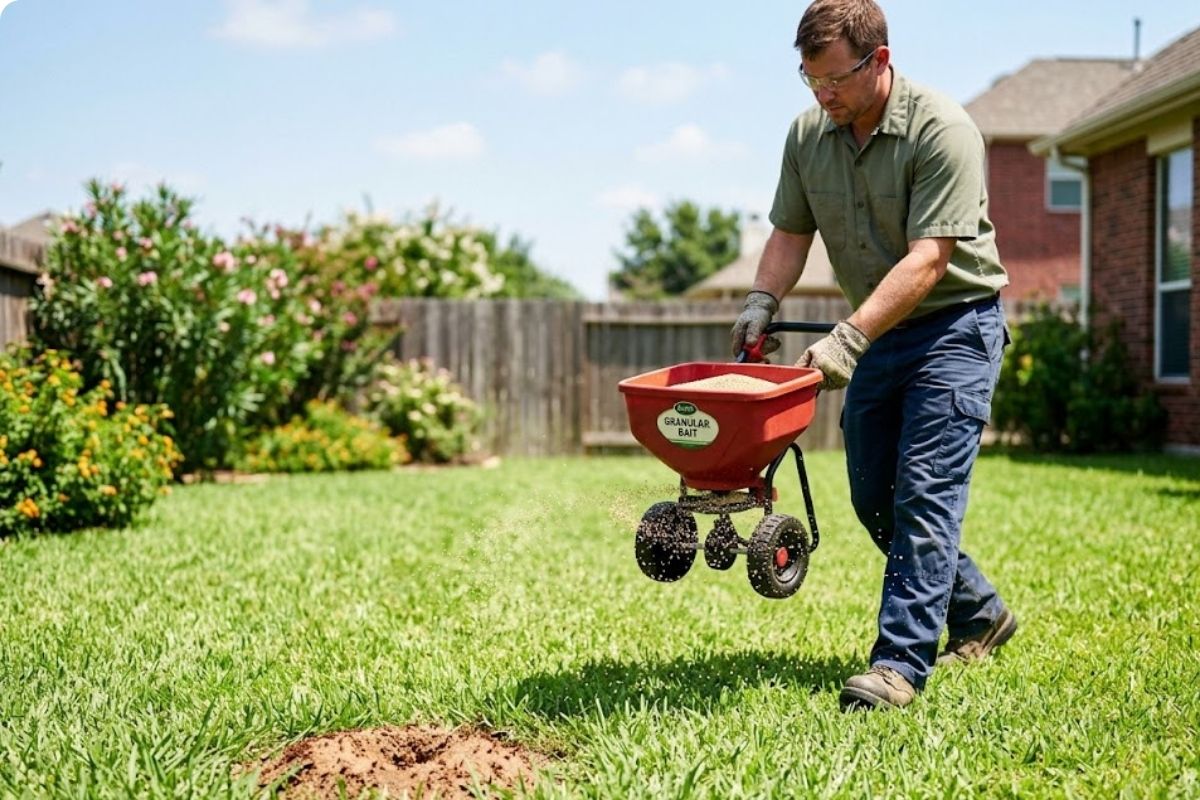
- Broadcast a fire ant bait over the whole yard when ants are actively foraging, applying to dry ground with no rain imminent, so workers collect it and carry it down to the queen and brood across all colonies, including the ones not yet mounded.
- Wait the period the bait needs to move through the colonies rather than judging it by the next day, since bait works through the colony gradually, not on contact.
- Treat individual mounds directly for colonies that are large, near walkways, play areas, or doorways, or that persist after baiting, so high-priority colonies get a faster knockdown.
- Re-inspect the yard after rain and through the storm-season surge, since relocated and new colonies surface in that period and need the cycle repeated.
- Repeat the broadcast-then-spot cycle on a recurring schedule, because the clay soil and climate keep producing new colonies no matter how well the current ones are cleared.
The order matters: broadcast first to reach the most colonies through their own foraging, spot-treat second for priority and stragglers, then repeat, because suppression in this soil is maintained, not achieved once.
Want this handled by a local pro? Call us.
Call (831) 703-7142 — Mon–Sat 7AM–7PM. No forms, just a real local team.
Call (831) 703-7142Timing, safety, and common mistakes
Timing is most of the battle. Bait applied when ants are not foraging, or right before rain that washes it away, largely wastes the application; dry ground and active foraging are the conditions that make it work. The biggest mistakes are surface-spraying or flooding a mound and considering it solved, which scatters foragers and relocates the queen rather than eliminating her, and treating reactively only after mounds appear instead of maintaining a cycle.
On safety, fire ant stings are a real concern, particularly for children, pets, and anyone with a sting sensitivity, so disturbed mounds near high-traffic areas deserve priority and care. Keeping people and pets off a freshly treated yard for the period advised, and not kicking or mowing over mounds, both reduce stings and avoid scattering colonies.
When to bring in a pro
A homeowner can run this cycle, and many do. It is worth bringing in professional service when the yard is large enough that consistent timing is hard to maintain, when colonies are persistently heavy despite a proper cycle, when stings are a genuine safety issue for the household, or when you would simply rather the suppression be maintained on schedule than managed reactively. Around the Valley the recurring nature of the problem is exactly why ongoing service tends to outperform a homeowner's stop-and-start effort, since the soil and climate never stop producing new colonies.
Whether handled yourself or professionally, the principle is unchanged: reach the queen through the colony's own behavior, prioritize the dangerous mounds, and treat suppression as a maintained condition rather than a finished task.
Frequently Asked Questions
The visible mound is just the roof over a colony that extends well below it, and the queen, the part that determines survival, is deep underground and never at the surface. Disturbing the top leaves an intact queen to repair or relocate and rebuild.
The clay and clay-loam soil mounds well and holds moisture, and the warm climate lets colonies grow large and stay active year-round with no winter knockback. After rain and during storm season, colonies relocate and surface, so a clear yard can fill with fresh mounds quickly.
Broadcast a bait over the whole yard while ants are actively foraging so workers carry it to the queen, then spot-treat large or high-priority mounds directly, and repeat the cycle. Broadcast first, spot-treat second, then maintain it.
When ants are actively foraging, on dry ground, with no rain imminent. Bait applied when ants are not foraging or right before rain that washes it away largely wastes the application, since timing is most of the battle.
No. Surface-spraying or flooding scatters foragers and relocates the queen rather than eliminating her, which is why the mound returns. Reaching the queen through baiting is what actually collapses the colony.
They are a real concern, especially for children, pets, and anyone with a sting sensitivity, so disturbed mounds near walkways, play areas, and doorways deserve priority and care. Keeping people and pets off a freshly treated yard reduces stings.
A homeowner can run the broadcast-then-spot cycle, but professional service tends to outperform stop-and-start effort because the soil and climate keep producing new colonies. A large yard, persistent colonies, or a safety concern are good reasons to bring in a pro.
Realistically no, because new colonies keep arriving and establishing in this soil and climate regardless of how well current ones are cleared. The achievable goal is sustained suppression maintained on a cycle, not a single permanent elimination.