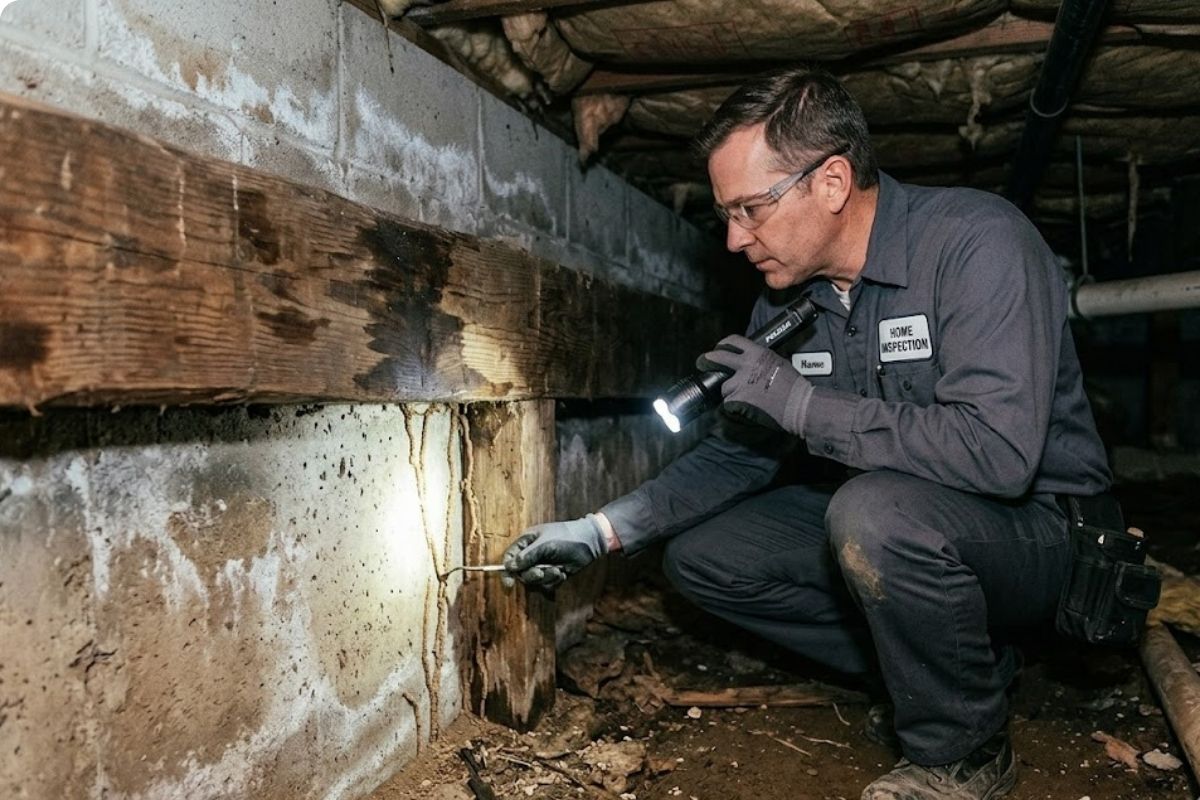
Why the visible signs are already late signs
Subterranean termites, the kind that matters most in Brownsville, work from the soil up, inside wood and behind surfaces. By the time a homeowner sees something, the colony has usually been active for a while. That is the central thing to understand about termite signs here: they are not early warnings in the way a leak under a sink is. They are confirmation that activity is already established, which is exactly why none of them should be filed under wait and see.
This matters in Brownsville specifically because the local conditions, flat clay soil that holds moisture against slabs and a climate with no winter dormancy, let colonies stay active and feeding across the whole year. There is no cold season quietly buying time, so a sign noticed in any month means activity that is currently ongoing.
The signs that actually indicate subterranean termites
A few signs are specific enough to take seriously. Mud tubes, pencil-width earthen tunnels running up a slab edge, pier, or foundation wall, are the most diagnostic; subterranean termites build them to travel between soil and wood while staying enclosed. Wood that sounds hollow when tapped or that flexes where it should be solid points to interior galleries. Discarded wings in small piles near windowsills or light sources after a warm, humid spell indicate a swarm originated in or near the structure. Paint that looks rippled or bubbled over wood can be the surface bulging above hidden tunneling. Floors, door frames, or trim that have shifted slightly out of true can reflect compromised wood beneath.
The unifying point is that all of these describe wood being eaten from inside while the outside still looks largely intact, which is why a quick glance so often misses them and why they are easy to dismiss individually.
Which signs mean call now and which mean monitor
Not every sign carries the same urgency, but in clay-soil, year-round-pressure Brownsville the threshold to act is lower than in milder regions. The table below sorts the common signs by how Brownsville conditions change their reading.
Want this handled by a local pro? Call us.
Call (831) 703-7142 — Mon–Sat 7AM–7PM. No forms, just a real local team.
Call (831) 703-7142Why Brownsville conditions raise the stakes on every sign
The same sign means more here than it would in a colder, drier place for two structural reasons. First, the flat delta clay holds moisture against slab foundations, and that persistent dampness is precisely what subterranean termites need at the soil-wood boundary, so a colony that finds a Brownsville slab has favorable conditions to keep expanding. Second, the absence of a real winter means no seasonal pause in feeding; damage that might accumulate over several active months elsewhere accumulates across all twelve here.
Together those mean a Brownsville sign is rarely a small isolated thing being noticed early. It is more often a mature, continuously active situation being noticed at all, which is the argument for treating any of these signs as a prompt for a professional inspection rather than a personal judgment call.
What to do when you see one, and how we help
The right response to any of these signs is the same: do not disturb mud tubes or probe deeply (that can scatter activity and make assessment harder), and get a professional inspection that locates the extent rather than guessing from the visible symptom. An inspection establishes whether what you see is the edge of something larger and what protection approach the structure and soil call for, which in Brownsville's clay is its own consideration.
Our Brownsville office at 3144 Boca Chica Blvd operates Monday through Saturday, 7AM to 7PM. If a termite issue covered under a treatment plan shows renewed activity between scheduled services, we return and re-treat without an added charge. To arrange an inspection after seeing any of these signs, call (831) 703-7142 and describe what you found and where in the structure it is.
| Sign | What it usually indicates | Reading in Brownsville conditions |
|---|---|---|
| Mud tubes on slab or foundation | Active soil-to-wood travel route | Call now, the most diagnostic sign, and year-round activity means it is currently in use |
| Hollow-sounding or flexing wood | Interior galleries already formed | Call now, indicates established feeding that does not pause seasonally here |
| Discarded wings in small piles | A swarm originated in or near the structure | Call now, points to a mature colony nearby in a climate that supports continuous swarming pressure |
| Rippled or bubbled paint over wood | Possible tunneling bulging the surface | Inspect promptly, easy to dismiss but often the only visible edge of hidden damage |
| Slightly shifted trim, frames, or floors | Possible compromised wood beneath | Inspect promptly, in clay soil with constant moisture this can progress faster than expected |
Frequently Asked Questions
No. Subterranean termites work out of sight, so visible signs confirm activity is already established rather than warning early. That is why none of them should be treated as wait-and-see, especially in year-round-active Brownsville.
Mud tubes, pencil-width earthen tunnels up a slab edge, pier, or foundation wall. Subterranean termites build them to move between soil and wood while staying enclosed, so they are the most specific indicator.
Flat clay soil holds moisture against slabs, exactly what subterranean termites need, and the absence of a real winter means no feeding pause, so damage accumulates across all twelve months rather than seasonally.
No. Disturbing mud tubes or probing deeply can scatter activity and make professional assessment harder. Leave it intact and get an inspection that locates the extent rather than guessing from the symptom.
Small piles of discarded wings near windowsills or light sources after a warm, humid spell indicate a swarm originated in or near the structure, which is a sign to have the structure inspected, not ignored.
It can be. Paint that looks rippled or bubbled over wood may be the surface bulging above hidden tunneling, which is one of the signs that looks minor but reflects interior wood being eaten.
If a termite issue covered under a treatment plan shows renewed activity between scheduled services, we return and re-treat without an added charge. Call (831) 703-7142 to arrange an inspection after seeing any sign.