One question, then the details
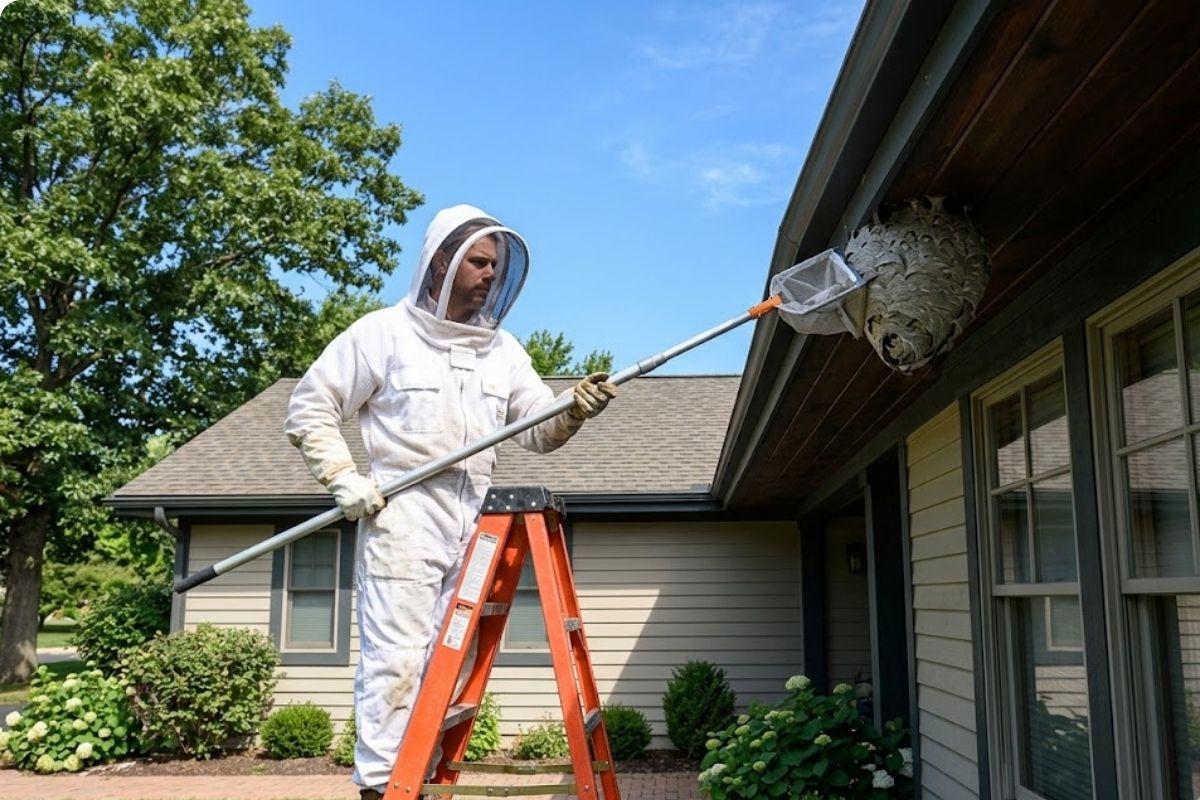
Most wasp and hornet decisions get over-complicated. Before identifying anything, run a single test: can this nest be reached from the ground, calmly, with a clear path to walk away, and is it small and exposed? If every part of that is true, it may be a reasonable do-it-yourself situation. If any part is false, a ladder is involved, the nest is large or enclosed, it is in a wall or soffit void, or anyone nearby has a sting allergy, the decision is already made, and it is a call-a-pro situation.
That rule resolves the large majority of cases on its own. The species, the cost, and the method matter, but they come after the access-and-risk question, because no amount of product knowledge makes a ladder over hard ground next to an agitated colony a good idea.
Why DIY nests go wrong, and what changes the risk
The reason the rule works is in how these go wrong. A disturbed nest does not flee; it mobilizes, and social wasps can sting repeatedly. A spray that does not reach the colony core mostly angers it, and a partial hit often leaves enough of the colony to rebuild or relocate nearby. Stack that onto a ladder over hard ground and the failure mode is stings plus a fall, which is the exact scenario behind most serious incidents.
Several factors push a borderline case firmly into pro territory: height and any ladder requirement, an enclosed aerial nest versus a small exposed comb, a concealed nest in a wall or soffit where the visible part understates the size, proximity to a doorway, walkway, or play area where disturbance is likely, and any known sting allergy in the household. Brownsville's warm climate also keeps colonies active over a long stretch, so a nest left to grow only gets larger and more defensive, which raises the risk the longer the decision is delayed.
Want this handled by a local pro? Call us.
Call (831) 703-7142 — Mon–Sat 7AM–7PM. No forms, just a real local team.
Call (831) 703-7142Handle-it vs call-a-pro at a glance
The comparison below turns the rule into a quick reference. Read it as: if a situation lands anywhere in the call-a-pro column, that overrides anything in the handle-it column, since risk does not average out. When unsure, the safe default is to treat it as a pro situation, and a quick phone description of location, size, and height is usually enough for a local pro to tell you how urgent it is and what it needs before anyone goes near it.
| Factor | May be handle-it | Call-a-pro |
|---|---|---|
| Reach | Ground level, clear exit | Ladder or height involved |
| Nest type | Small, exposed comb | Large or enclosed aerial nest |
| Location | Open, away from traffic | Wall or soffit void, near doors |
| People nearby | No allergy, low traffic | Known sting allergy in household |
| Certainty | Clearly low risk | Any doubt, or growing nest |
Frequently Asked Questions
Run one test: can it be reached from the ground, calmly, with a clear path to walk away, and is it small and exposed? If all of that is true it may be reasonable to handle. If any part is false, it is a call-a-pro situation.
A disturbed nest mobilizes rather than flees, and social wasps sting repeatedly. Spray that misses the colony core mostly angers it, and combined with a ladder over hard ground the failure mode is stings plus a fall, the scenario behind most serious incidents.
A ladder requirement or height, an enclosed aerial nest, a concealed nest in a wall or soffit, proximity to a door, walkway, or play area, or any known sting allergy in the household. Any one of these overrides a handle-it assessment.
Yes. A small exposed comb is a different risk than a large enclosed aerial nest, and a concealed nest's visible part often understates its true size. Larger and enclosed nests carry more colony and more defensive response, pushing toward a pro.
Generally no. Brownsville's warm climate keeps colonies active over a long stretch, so a nest left to grow only gets larger and more defensive. Delaying the decision tends to raise the risk rather than lower it.
Treat it as a pro situation by default, since risk does not average out, one severe factor outweighs several mild ones. A quick phone description of location, size, and height usually lets a local pro tell you how urgent it is before anyone approaches it.
Usually they are lower risk than paper wasps or hornets and many people simply want them removed for appearance, but the same access-and-risk rule still applies, height, enclosure, or allergy concerns move even a low-aggression nest toward a pro.