Traveling Out to Edinburg for Pest Work
Edinburg is the Hidalgo County seat and a sizable city in its own right. We reach it as honest travel-out coverage from Brownsville, not from a branch there.
A county seat we cover from a distance
Edinburg is the Hidalgo County seat, with a university presence, county government buildings, and a fast-expanding ring of subdivisions wrapped around an older central core. We travel to it from 3144 Boca Chica Blvd in Brownsville, a little over an hour out along the mid-Valley corridor, and we keep that framing honest: there is no Edinburg office and no local crew. The coverage is real; the way it reaches Edinburg is stated plainly so owners can plan around it.
As with any travel-out location, the honest version is that scheduling is planned around the drive rather than around a pretended local presence. Edinburg's scale, a major institutional footprint plus a large residential ring, means a visit is scoped carefully in advance so the trip addresses the whole property rather than requiring repeated short runs the distance does not support. The travel is part of the quoting conversation up front, not a surprise after the fact.
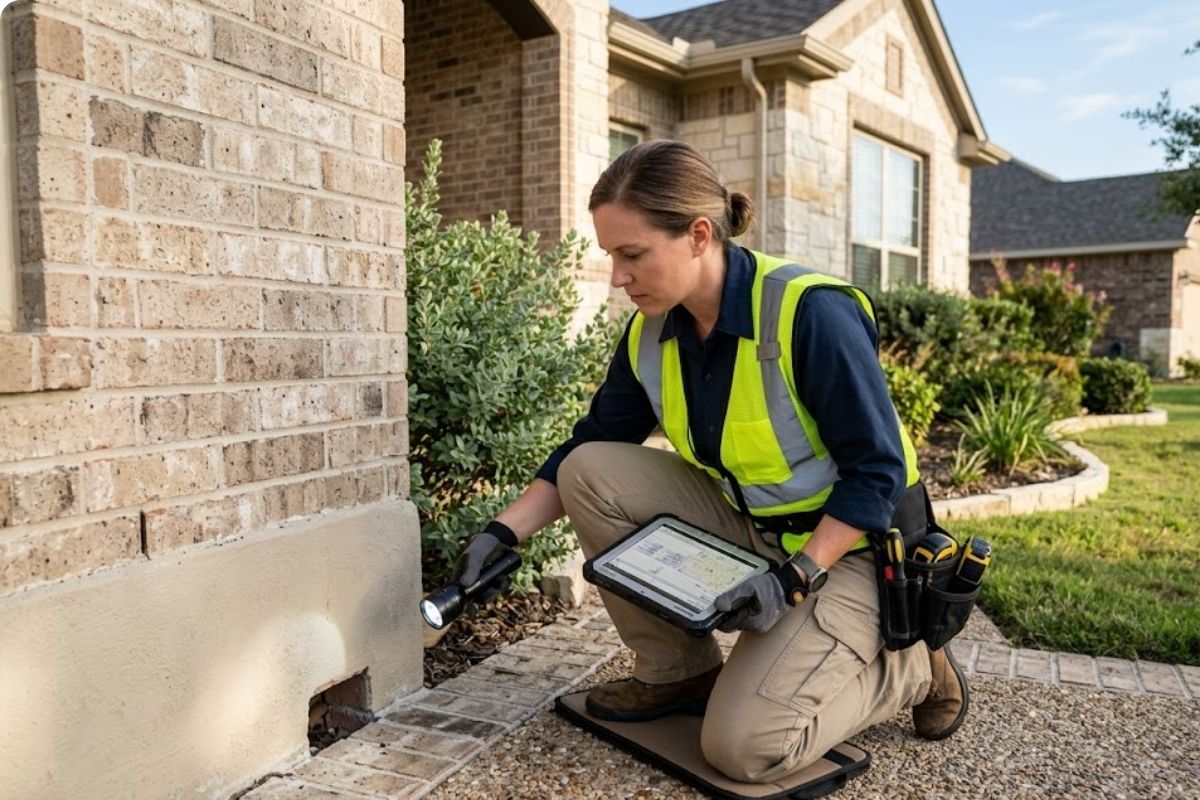
The institutional fabric and what it concentrates
A county-seat city concentrates the structures where pests persist, and Edinburg's are worth being specific about. Older institutional and downtown buildings, around the courthouse, the campus, and the historic core, are old enough to carry original construction details, long slab-soil contact in the flat clay, and aging seals: precisely the structural recipe that favors subterranean termites and gives roaches and rodents accessible routes in and between buildings. Government, campus, and food-service blocks concentrate German roach and rodent pressure that moves between adjoining tenants along shared walls and utilities rather than staying contained to one unit.
The rapidly built outlying subdivisions tell the other half of the story. Newer construction has fewer aging-foundation problems and tighter envelopes, but the freshly graded clay-loam lawns are prime fire-ant ground that rebuilds after irrigation and rain, and the irrigation keeping new landscaping green sustains mosquitoes through the warm year. Edinburg's profile is genuinely split between the institutional core and the new edge, and the two need different reads rather than one template.
The year-round engine underneath all of it
Whatever the structure type, the underlying driver is the Valley's climate. With no real winter cold to knock populations back, Edinburg's termites, fire ants, mosquitoes, roaches, and rodents are a twelve-month condition rather than a seasonal one. There is no dormant stretch during which a missed colony sits harmlessly or an untreated yard quietly resets itself.
The institutional and subdivision specifics decide where pressure concentrates; the subtropical baseline decides that it never genuinely stops. That is why extended-area work in Edinburg is framed as ongoing rather than a single visit, the supply of pressure is continuous, so a maintained rhythm holds where a lone distant trip does not. We are direct about that distinction rather than implying a one-time pass solves a year-round problem at this range.
This is also why a Edinburg property's history matters to the plan. A site with a prior termite or rodent issue sits on conditions that did not change when the visible problem was cleared, and in a climate with no dormant season those conditions keep working year-round, so the interval between professional visits is doing more here than it would somewhere with a real winter. We weigh that history explicitly when setting a cadence rather than treating every address as a blank slate.
Pest problem in Edinburg? Call now.
Call (831) 703-7142 — Mon–Sat 7AM–7PM. No forms, just a real local team.
Call (831) 703-7142Booking a trip out, plus the adjacent towns on the same run
Because Edinburg is travel-out service, coverage starts with a call that scopes the job and schedules it with the drive accounted for. The most useful detail a caller can give is which side of the split the property sits in, the institutional and older core, where structural and exclusion work leads, or the newer subdivision edge, where yard-level source reduction leads, because that single fact reorders the whole plan.
On the same mid-Valley run we also reach McAllen, Pharr, and Mission, so a multi-location issue is handled efficiently rather than piecemeal across separate trips. We work Monday through Saturday, 7AM to 7PM, and if a covered pest reappears between scheduled visits in this extended area, the return treatment is provided at no extra cost. Reach us at (831) 703-7142 to scope the Edinburg property and set up the visit, and we will explain honestly how the extended-area scheduling works for it.
Frequently Asked Questions
We travel out from Brownsville, a little over an hour away; there is no Edinburg office and no local crew. The coverage is genuine and the way it reaches Edinburg is stated plainly.
Yes. A county-seat city concentrates older institutional and downtown buildings with structural termite and roach vulnerability, plus dense commercial and food-service blocks where roaches and rodents move between adjoining tenants.
They are. Rapidly built subdivisions have fewer aging-foundation problems but fresh clay-loam lawns where fire ants establish and irrigation that sustains mosquitoes, so the profile splits between core and edge.
The Valley's climate gives no real winter cold to knock populations back, so termites, fire ants, mosquitoes, roaches, and rodents stay active across all twelve months rather than easing seasonally.
On the same mid-Valley run we also reach McAllen, Pharr, and Mission, so a multi-location problem can be handled efficiently rather than piecemeal across separate trips.
If a covered pest reappears between scheduled visits in this extended area, the return treatment is provided at no extra cost. Reach us at (831) 703-7142 to scope the property and set up the visit.