Bringing Pest Service Out to Mission
Mission carries the Valley's citrus heritage and is still wrapped in farmland. We travel out to it from Brownsville and say so plainly.
Citrus country, reached on a drive from Brownsville
Mission holds the Valley's citrus legacy west of McAllen along US-83 and remains ringed by agricultural land even as the city itself has grown. We drive out to Mission from 3144 Boca Chica Blvd in Brownsville, around an hour and ten out; there is no Mission office and no crew based there. The agricultural setting, more than the city limits, is the right place to start understanding its pests, and the honest framing is the same as for any location at this distance: the drive is built into the scheduling conversation rather than disguised as a local branch. The travel is part of the quoting conversation honestly, never a figure adjusted after the fact.
What makes Mission worth reading on its own is that the groves and row-crop land are not a distant backdrop but pressed right against much of the residential development, so the field-edge pattern reaches further into the town than it would in a more buffered city. A trip out is planned to cover the property fully rather than in repeated short visits the distance does not support.
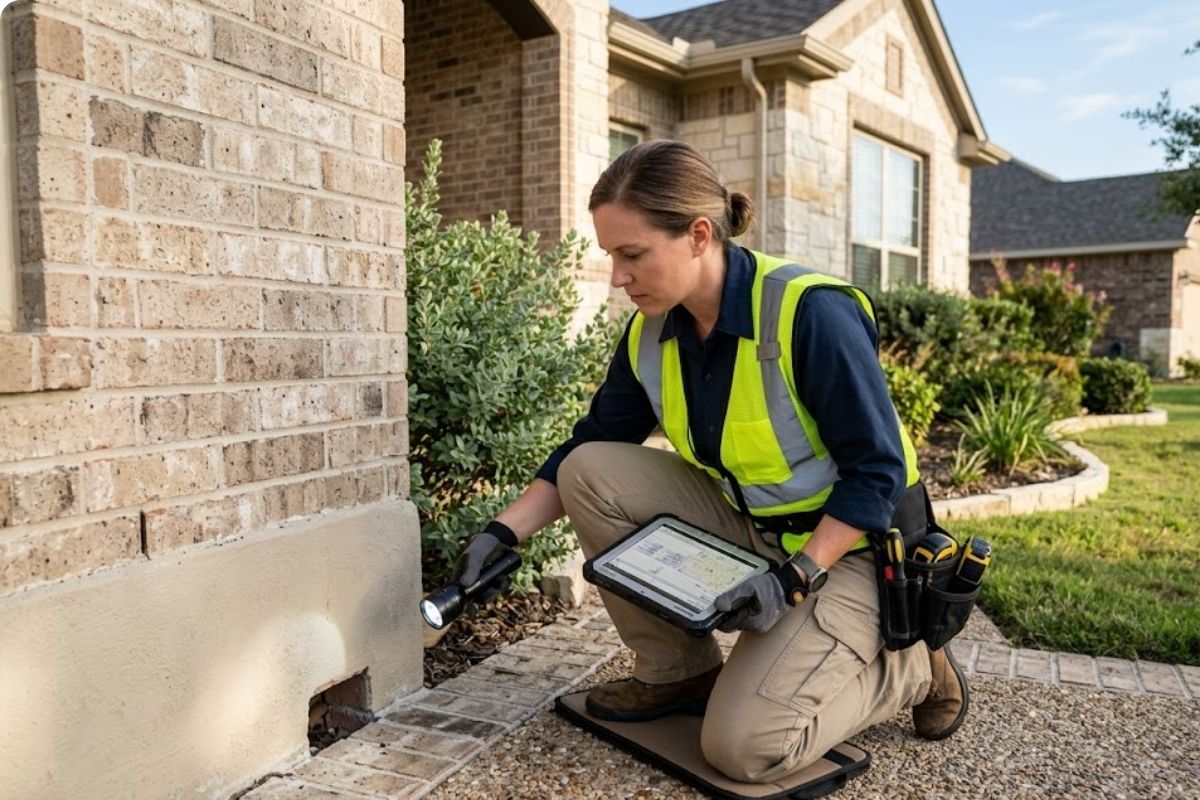
What groves and irrigation put on a property
The citrus and row-crop land around Mission, with its irrigation canals and field-edge water, produces a recognizable sequence. Irrigation keeps water available through dry stretches on a crop schedule rather than a rainfall one, so mosquito production continues across the warm year rather than only after rain. Harvest and field turnover push displaced rodents toward the structures nearest the groves, and because the agricultural land sits so close to housing, that push reaches well into residential blocks rather than stopping at a rural margin. The clay-loam soils along the agricultural edge mound up with fire ants that rebuild after each irrigation and rain cycle.
Nearer the older town center the pattern shifts to the structural one: original construction and decades of slab-soil contact favor subterranean termites and give roaches and rodents accessible routes. With the Valley's no-winter-knockback climate beneath all of it, none of this resets seasonally; the grove and irrigation rhythm shifts where pressure concentrates from month to month but does not switch it off. Which of these a Mission property faces depends almost entirely on how close it sits to the working land versus the older core.
It is worth adding that the irrigation timetable, not the weather, is what a Mission mosquito program has to track. Because canal and field watering follows the crop calendar, standing water appears on a schedule a rain-based plan would miss entirely, and source reduction here means walking the property against that irrigation rhythm rather than reacting after storms. The same dispersed agricultural moisture is what lets American roaches build outdoor populations that then press toward grove-adjacent homes, so the water and the structure questions are connected rather than separate.
Pest problem in Mission? Call now.
Call (831) 703-7142 — Mon–Sat 7AM–7PM. No forms, just a real local team.
Call (831) 703-7142Arranging the visit and the nearby towns we also serve
Mission being travel-out service means the first step is a call that scopes the work and schedules it honestly around the drive. The most useful thing a Mission caller can describe is the property's position relative to the groves and fields, because that determines whether the visit is weighted toward harvest-aware rodent and fire-ant work, irrigation-driven mosquito source reduction, or the structural read of the older core. Naming that up front lets the single trip out target the right work instead of a generic sweep.
On the same western run we also reach McAllen, Palmview, and Edinburg, so a problem spanning those communities is handled on one trip rather than fragmented across separate ones. We work Monday through Saturday, 7AM to 7PM, and where a covered pest returns between scheduled visits in this extended area, we come back and re-treat it at no charge added. The recurring-coverage point applies here as everywhere in the Valley: no seasonal reset means maintained service holds where a single distant trip does not, and we say that plainly rather than overselling a one-time fix. Phone (831) 703-7142 to describe the Mission situation and arrange coverage.
Frequently Asked Questions
We drive out from our Brownsville base, around an hour and ten away; there is no Mission office and no crew based there. It is genuine extended-area coverage with the travel stated plainly.
A city wrapped in groves and irrigated farmland faces field-driven pressure: irrigation-fed mosquitoes, post-harvest rodent movement toward grove-adjacent structures, and fire-ant mounding in clay-loam agricultural-edge yards.
Yes. Nearer the older center, original construction and slab soil contact bring the structural termite and roach angle, distinct from the grove-edge field pattern that dominates closer to the working land.
The Valley's climate gives no winter knockback, so the grove and irrigation rhythm shifts where pressure concentrates but does not stop it; mosquitoes, termites, fire ants, and rodents stay active all year.
On the same western run we also reach McAllen, Palmview, and Edinburg, so a problem spanning those communities is handled on one trip rather than fragmented across separate ones.
Where a covered pest returns between scheduled visits in this extended area, we come back and re-treat it at no charge added. Phone (831) 703-7142 to arrange coverage.