Wasp and Hornet Nest Removal Done Safely
The most expensive wasp mistake in Brownsville is a ladder, a spray can, and an aggravated nest. Here is why this one is worth a call rather than a try.
Why a do-it-yourself nest goes wrong
Wasp and hornet removal is the safe elimination of a stinging-insect nest and the colony inside it, ideally before the colony reaches the size where it defends aggressively. The reason this service exists is simple: the typical homeowner attempt, a spray can and a ladder at dusk, is exactly the scenario that produces multiple stings and a fall.
A disturbed nest does not retreat; it mobilizes. Spray that does not reach the core of the nest mostly angers the colony, and a partial knockdown often leaves enough workers to rebuild or to relocate nearby. Unlike a bee colony, social wasps can sting repeatedly, and an aerial nest tucked under an eave or in a tree puts the person on a ladder above hard ground while being stung. In our experience the calls that turn into emergency-room visits here are almost always a DIY attempt that went sideways, not the original nest itself.
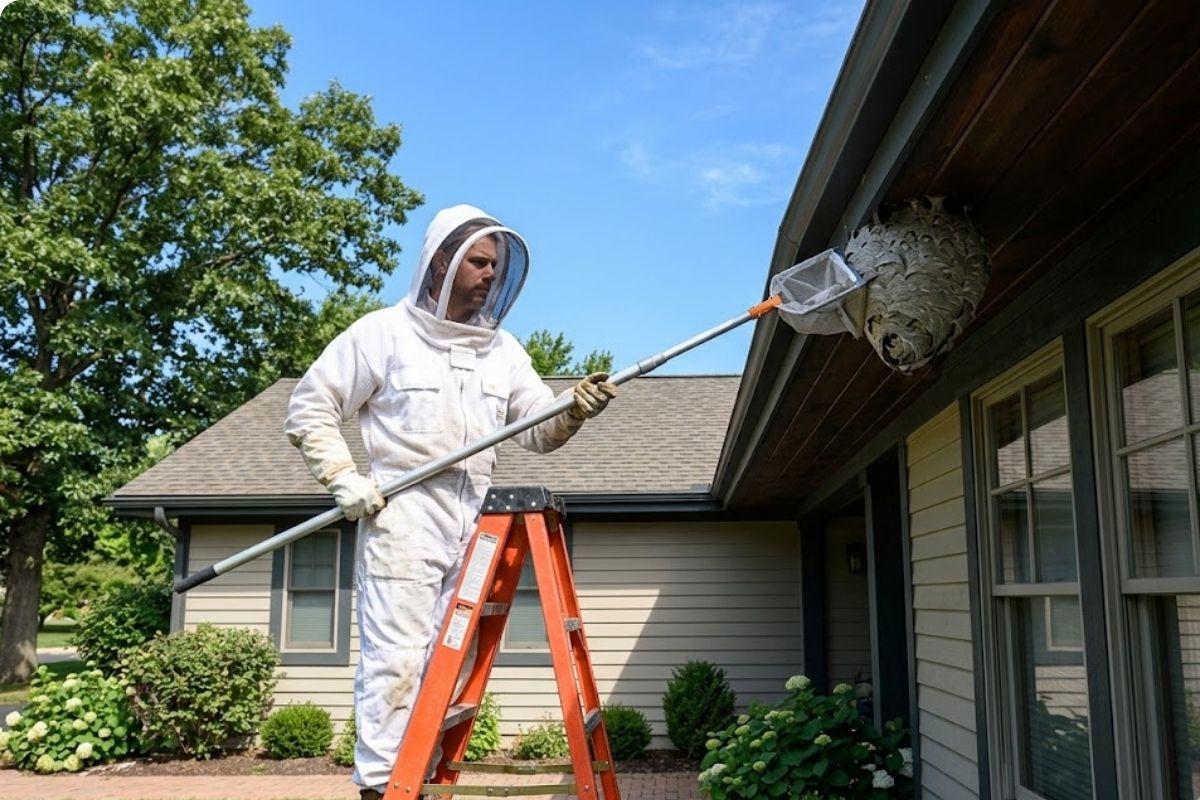
What's nesting around Brownsville homes
The warm subtropical climate keeps stinging insects active across far more of the year than colder regions get, so nests here are not strictly a midsummer issue. Paper wasps build the familiar open, umbrella-shaped combs under eaves, in porch corners, soffits, and patio furniture. Mud daubers leave the hard tube nests on walls and under overhangs; they are generally far less aggressive but homeowners often want them gone anyway. Bald-faced hornets and other aerial nesters build the large enclosed paper nests in trees and on structures, and those are the ones that escalate fastest when disturbed.
Around Brownsville we typically see nest activity build through the warm months and surface around eaves and structural voids that offer shelter, including spots people only discover by walking into the flight path. Identifying which insect built the nest matters, because the right and safe approach differs between an exposed paper-wasp comb and a large enclosed hornet nest.
How we remove a nest
The goal is to neutralize the colony with controlled exposure to people, then deal with the physical nest appropriately.
- Identify and locate the species and the full extent of the nest, including hidden combs in voids that the visible part does not reveal.
- Treat the colony directly with the right method for that nest type, timed to when activity is lowest, so the core is reached rather than just the outer workers.
- Remove or disable the nest as appropriate and address the harborage so the same eave or void is less likely to be reused.
- Advise on prevention for the structural spots that keep attracting nests on that particular home.
In our experience reaching the colony core in one controlled treatment is what prevents the rebuild-and-relocate cycle that DIY attempts usually trigger.
Need a wasp and hornet removal in Brownsville?
Call (831) 703-7142 — Mon–Sat 7AM–7PM. No forms, just a real local team.
Call (831) 703-7142What removal costs
Honest pricing depends on the species, the size and accessibility of the nest, the height and whether ladder work or a structural void is involved, and how many nests are present. A single low, accessible paper-wasp comb is the low end. A large enclosed aerial hornet nest, a nest concealed inside a wall or soffit void, or multiple nests around a property sits higher because the access and risk are greater.
Around Brownsville we typically find that properties with repeated nesting in the same eaves benefit from addressing the harborage rather than just removing nest after nest, and recurring exterior service can keep new nests from establishing in the first place. We give a real range by phone after asking where the nest is, how big, and how high; if a covered nest re-establishes between scheduled visits, we return and re-treat at no additional charge.
When to call instead of reaching for a can
A nest near a doorway, walkway, play area, or anywhere it sits in a daily path is worth handling promptly because incidental disturbance is likely. A large enclosed aerial nest, any nest that requires a ladder, a nest in a wall or soffit void, or a situation where someone in the household has a known sting allergy are all clear reasons not to attempt it yourself.
Our phone is staffed Monday through Saturday, 7AM to 7PM, and the office sits at 3144 Boca Chica Blvd in Brownsville. Describe the nest's location, rough size, and height when you call (831) 703-7142 and we can usually tell you how urgent it is and what approach it needs before we arrive.
Frequently Asked Questions
Hardware-store spray often fails to reach the colony core and mainly provokes the workers, which can sting repeatedly. Combined with a ladder over hard ground, that is the exact scenario that causes the stings and falls we see most, so a controlled professional treatment is genuinely safer.
They are active across far more of the year here than in colder regions because the subtropical climate never forces a hard seasonal shutdown. Activity builds through the warm months, so nests are not strictly a peak-summer concern.
Paper wasps build open umbrella-shaped combs under eaves, mud daubers leave hard tube nests on walls, and bald-faced hornets build large enclosed paper nests in trees or on structures. The species changes the safe approach, so we confirm it before treating.
They are generally far less aggressive than paper wasps or hornets, but many homeowners still want the hard tube nests removed for appearance or peace of mind. We can remove them and advise on the spots that keep attracting them.
Concealed nests are a strong reason not to attempt removal yourself, since the visible part rarely shows the true size and disturbing it indoors can drive the colony into living space. We locate the full extent before treating.
It depends on the species, the nest's size and accessibility, the height and whether ladder or void work is needed, and how many nests there are. We give a real range by phone, and a re-established covered nest between scheduled visits is re-treated at no extra charge.
Often, yes. Properties with repeated nesting in the same eaves usually have harborage worth addressing, and recurring exterior service can stop new nests from establishing rather than just removing them one after another.